The award-winning suspended access innovation that helped restore the US Holocaust Memorial Museum’s bridges–without leaving a trace
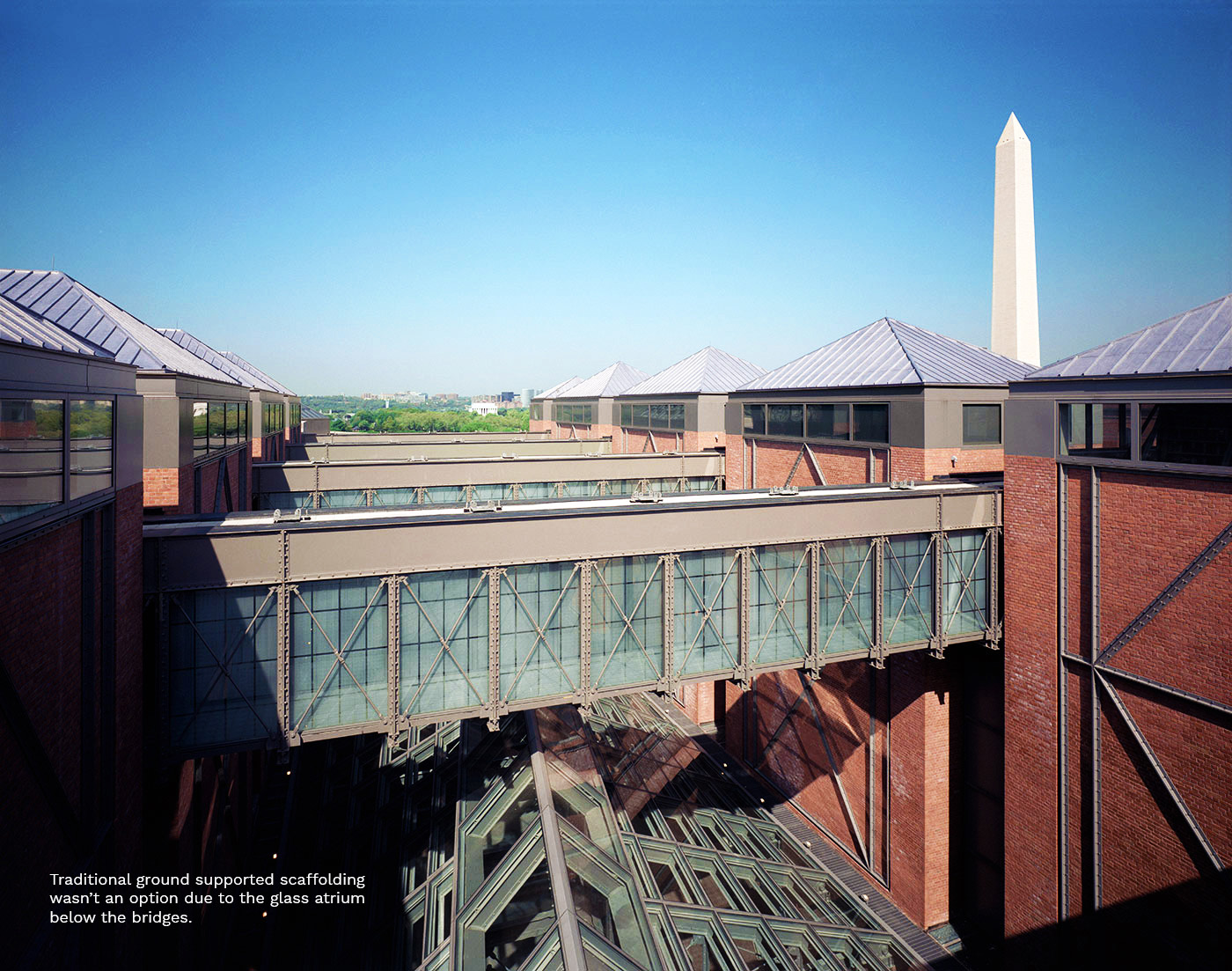
The five pedestrian bridges spanning the US Holocaust Memorial Museum in Washington, DC, carry more than foot traffic. Their glass panels bear the etched names of communities destroyed during the Holocaust. Thousands of lives reduced to memory, preserved in architecture.
After three decades of weathering the capital’s harsh elements, these memorial bridges needed restoration. But accessing them would require engineering precision, collaboration, and an awareness that some projects demand more than technical excellence. Beneath the bridges sits a glass atrium. Above them, museum operations continue daily. The restoration crew would need to work suspended in mid-air, protecting both the fragile glass below and the mission surrounding them.
“Once we were briefed on the access requirements and the constraints involved, we went straight into problem solving mode,” says Brian Andrews, VP Engineering at Bee Access. What emerged was a suspended access solution that had never before been attempted by either Bee Access or their partner, Scaffolding Solutions.
When Scaffolding Solutions contacted Bee Access in early March 2024, the access challenge was immediately clear. MCA Construction had won the contract to repaint all five memorial bridges, and they needed access to every surface while the museum remained open to the public.
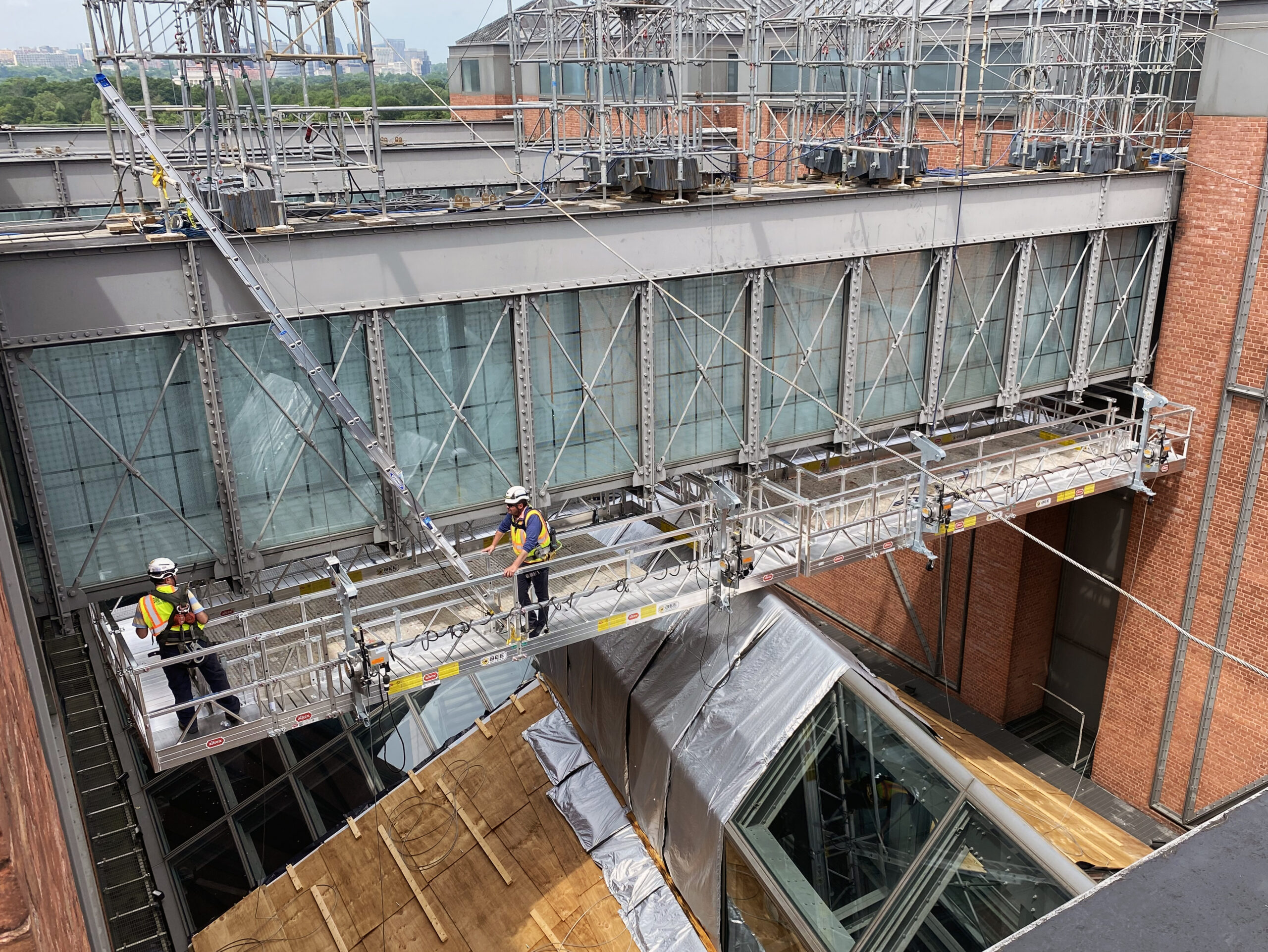
The constraints weren’t just challenging. They were absolute. Traditional ground-supported scaffolding wasn’t an option. The glass atrium below the bridges eliminated any possibility of loading from beneath. Every pound of support would need to come from above.
“Suspended access was the only viable solution for this job due to the design of the surrounding structure,” Andrews explains. “A glass atrium below the bridges not only limited the work to access solutions supported from above, but it also posed an increased need for flawless execution due to the delicacy of the surface below.” Then there was the geometry problem. At 71/2 feet wide, the bridges were in an awkward middle ground. Too wide for standard straight platforms to safely reach the underside from one edge. Too narrow to accommodate both the necessary support rigging and the assembly of a conventional dancefloor platform on the deck itself.
“The width of the bridges was too wide to access the underside with typical porch systems from a standard straight platform, which only left a dancefloor as the platform option,” Andrews explains. “However, the bridge was so narrow that it did not leave enough room to construct both the necessary beam support system and also assemble and deploy the platforms.”
Dancefloors (large, stable platforms that provide continuous work areas) are typically assembled on the ground and hoisted into position. With the glass atrium below ruling out that approach, Bee Access engineers had to reverse the process. The dancefloor would need to be assembled and deployed from above.
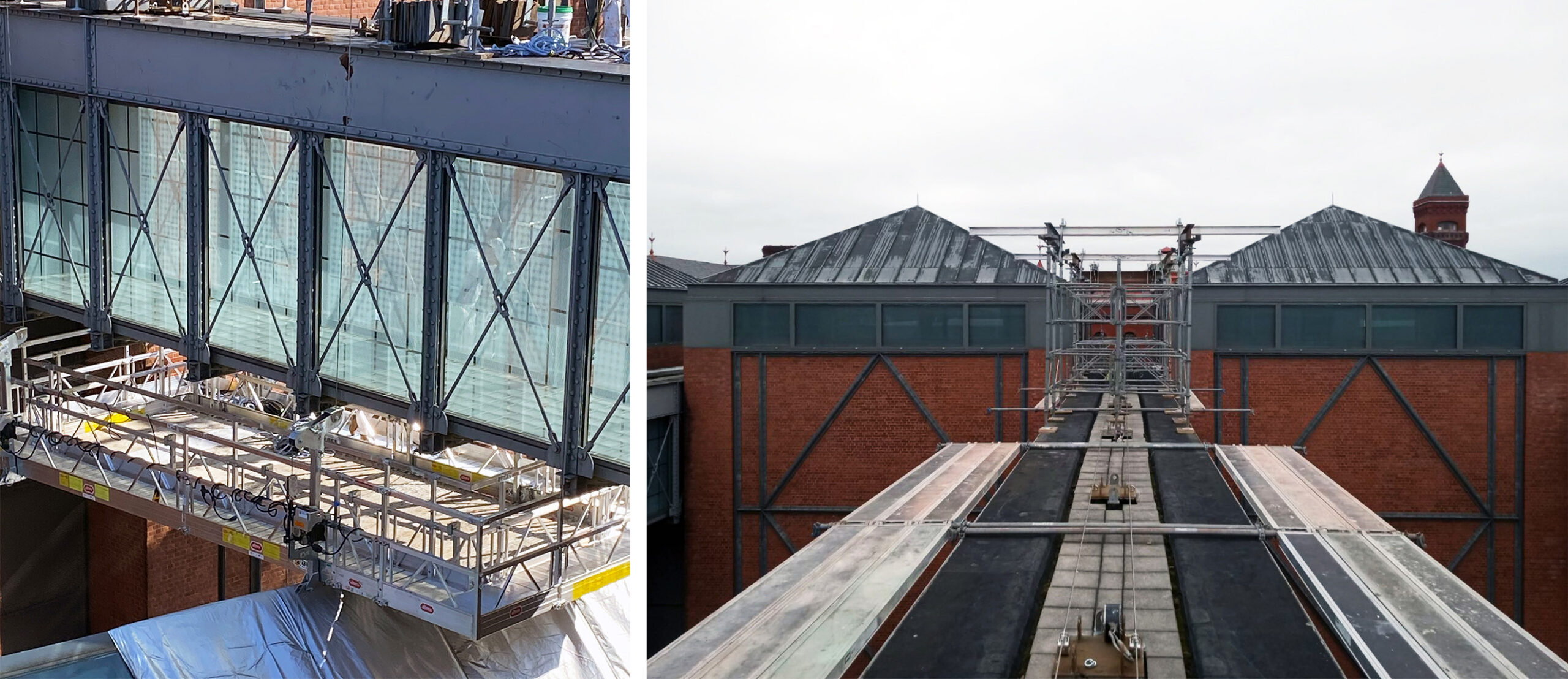
The idea the team developed was simple in theory, but complex in execution. Two long platform sections would be assembled on temporary staging decks built on each bridge roof. These sections would be ‘roof-launched’, which means lowered on either side of the bridge using a carefully engineered rigging system. Once in position, the two sections would be connected mid-air beneath the bridge deck, creating a complete rectangular dancefloor suspended in space.
“Though designing a roof launched system is not an uncommon task for the Bee Access engineering team, launching a dancefloor would be a first,” Andrews notes.
“Launching a dancefloor from the roof would be a first for the team.”
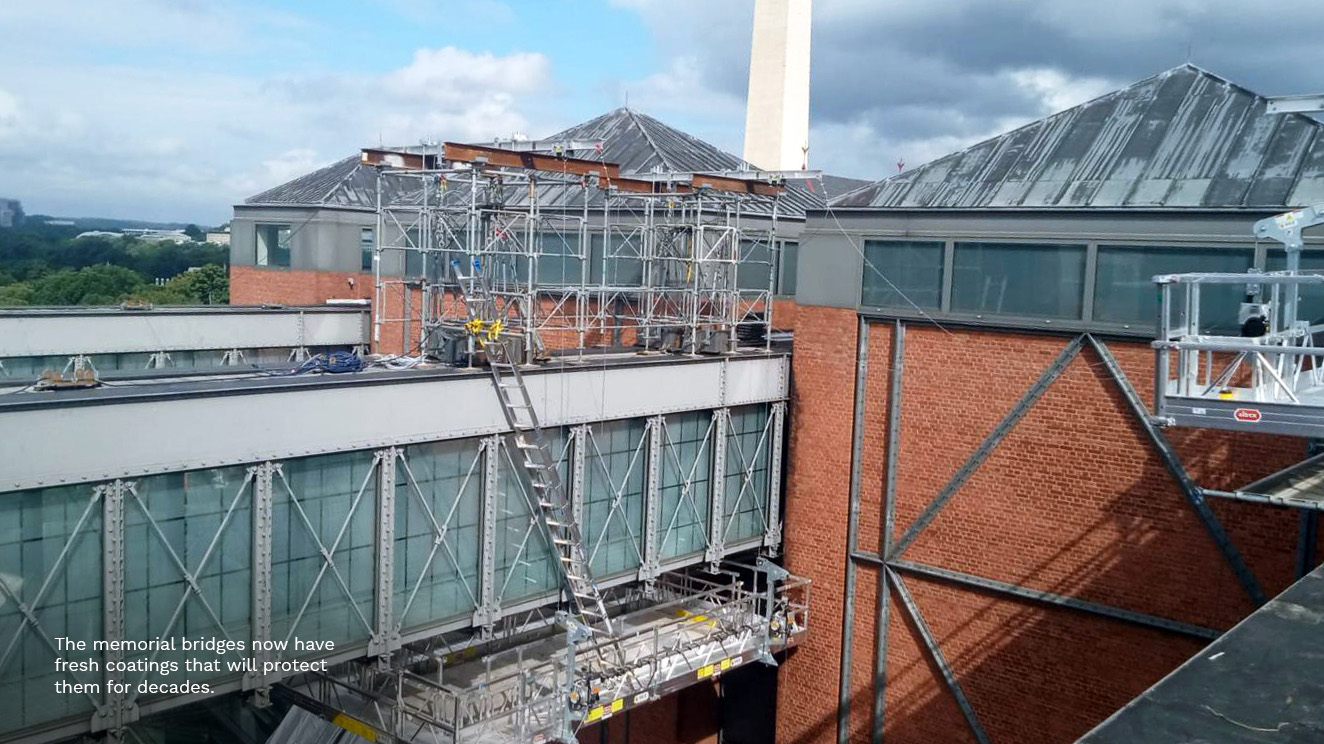
The rigging system had to solve multiple problems at once. With only 71/2 feet of width on each bridge deck, the team designed specialized beams with rigging points on both ends and mounted them on top of scaffold support towers. These towers needed sufficient height to accommodate the fully assembled platforms during the roof launch, but they also needed to maintain proper aspect ratios for stability, which took up nearly the full width of the bridge.
That created a new problem. There was no space left to assemble the platforms.
The solution came in the form of temporary cantilever decking. This was an engineered workspace that extended beyond the edges of each bridge. Using beams installed perpendicular to the support towers, the team created a safe platform where workers could build each section of the suspended system.
“Success transcends schedule and budget. It’s about preserving the integrity of a historically significant structure.”
“Most visitors will never notice how complex the access challenge truly was.”
“We identified early on that once the rigging towers were in place, there wouldn’t be enough room to assemble swing stage baskets,” Austin Leckinger, Project Engineer at Bee Access, explains. “The solution was to extend scaffolding platforms from the bridge edges, creating the space needed to assemble and deploy the system safely.”
Once assembled on the temporary decking, each platform section could be raised a few inches, the cantilever deck removed, and the platform lowered into position. This sequencing made the entire system possible.
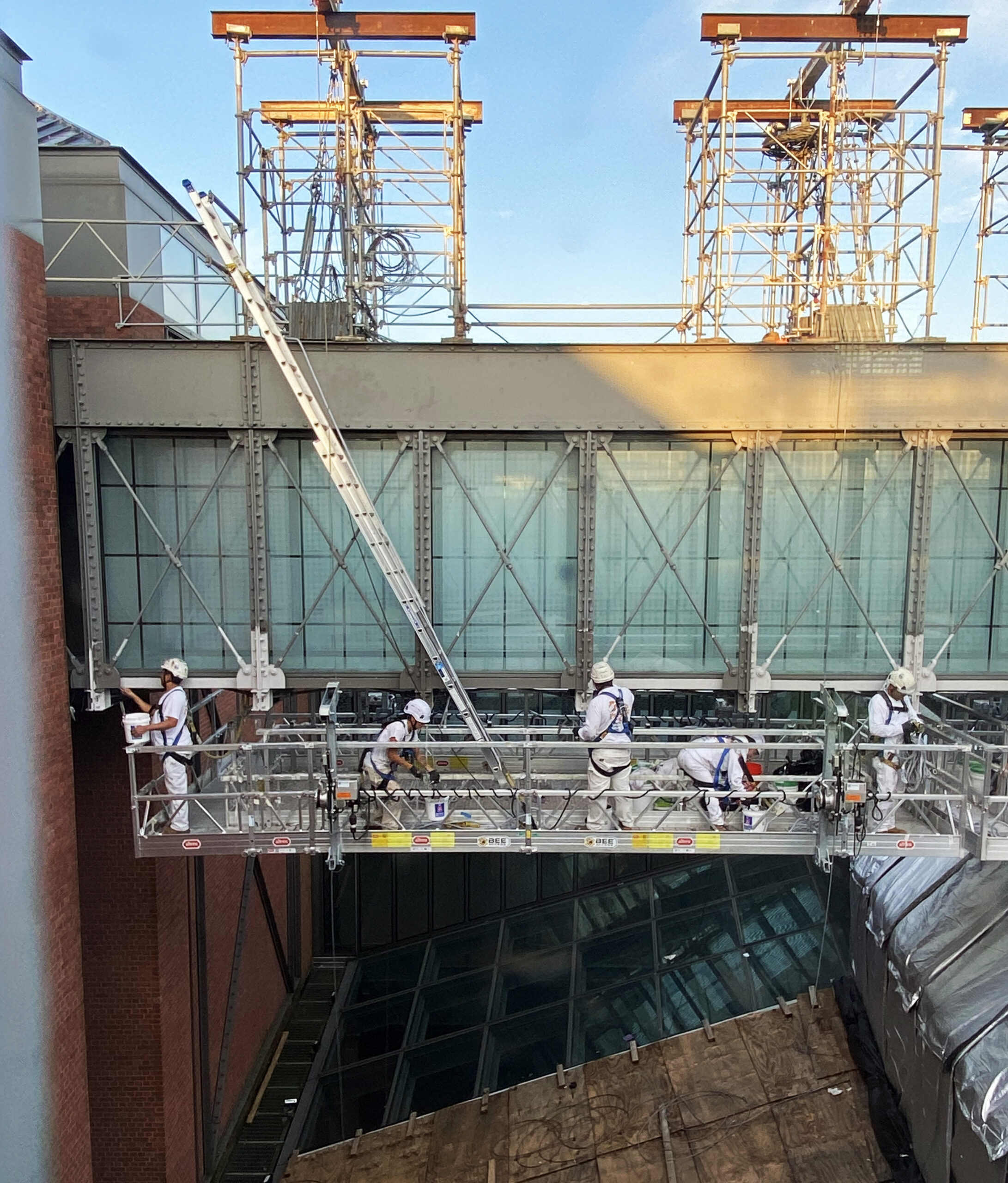
Up to 15 crew members could work at the same time on the platforms suspended on either side of each bridge. “The suspended access system significantly boosted productivity by allowing up to 15 crew members to work simultaneously on each bridge in a safe, organized manner,” Leckinger explains.
Once the side work was complete, center platform sections were installed to connect the two straight sections beneath the bridge deck. Workers added scaffold tubes and planks, creating a continuous work surface spanning the entire underside of each bridge.
Before a single component went up, Bee Access calculated the loads at each support location. “The key engineering consideration regarding load paths was the need to ensure that the bridges could withstand the counterweight and fulcrum loads at each location where the supports were needed,” Leckinger explains. This verification process meant the museum’s existing structure became part of the access system, safely bearing the forces without any changes to the historic bridges.
Given the museum’s symbolic importance and constant public presence, the project required safety measures that went beyond OSHA minimums.
“Safety was the top priority, especially given the site’s high public visibility and symbolic significance,” Leckinger emphasizes. The team incorporated 90-degree turnback components, lanyards on all components, and dedicated hooks. Every component was secured. Every movement was controlled. Every potential risk was addressed through built-in redundancy.
Scaffolding Solutions developed a job-specific fall protection and rescue plan, conducted daily safety briefings, and maintained regular inspections throughout the project. Their field crew underwent specialized training for suspended scaffold installation and operation in sensitive environments.
The result? Zero incidents across the entire project, from early 2024 through completion in March 2025.
“A glass atrium below meant all access had to be supported from above.”
While the technical access challenges were significant, the project’s human dimension was equally important. The museum remained fully operational throughout the restoration.
“Since the museum remained open throughout the project, meticulous planning and communication were vital,” Carlos Rodriguez, Project Manager at Scaffolding Solutions, notes. “Scaffolding Solutions conducted multiple site visits with the client and all involved trades to coordinate logistics, sequencing, and daily operations.”
The success of the project lies partly in what museum guests didn’t notice: the work happening just above and around them.
The Holocaust Memorial project was a case study in how companies can work together effectively. Bee Access provided engineering expertise and the new dancefloor deployment method. Scaffolding Solutions brought field execution excellence and stakeholder coordination. MCA Construction managed the overall restoration timeline and quality.
“Early planning, collaboration, and proactive communication are essential in sensitive environments like this,” Rodriguez reflects.
The $600,000 project met its timeline and budget targets, but those numbers tell only part of the story.
For projects at memorial sites, the usual success metrics (on time, on budget, zero incidents) are necessary but not enough. The deeper measure is whether the work honors the space it occupies.
“On a project of this nature, success transcends schedule and budget,” Rodriguez reflects. “It is defined by the team completing the work safely, ensuring the public experience remains unaffected, and preserving the integrity of a historically significant structure.”
The memorial bridges now have fresh coatings that will protect them for decades. Museum operations never paused. Not a single visitor had to detour because of scaffolding. Not one panel of the glass atrium was damaged. Not one worker was injured.
When Scaffolding Solutions removed the final components of the access system, they left nothing behind. No bolt holes. No attachments. No evidence that one of the industry’s most complex suspended access projects had just been completed overhead.
The Holocaust Memorial Museum project reinforced principles that go beyond technical execution. Some lessons can only be learned by working in spaces that demand both skill and respect.
“This project reinforced the importance of early planning, robust collaboration, and proactive communication when working in sensitive environments,” Rodriguez reflects. “Moving forward, the team will continue to engage stakeholders early, identify potential risks in the pre-construction phase, and design access solutions that prioritize public safety while respecting the site’s importance.”
The memorial bridges aren’t just structural elements that needed paint. They’re part of a space dedicated to remembrance, education, and bearing witness to history. “As access solutions are removed and no trace of the work remains, the memorial bridges continue to serve their purpose quietly,” Rodriguez observes. “The success of the project lies in the fact that most visitors will never notice how complex the access challenge truly was.”
That invisibility is the mark of good work. The ability to do something extraordinarily complex without disrupting what matters.
The names etched into those bridges will continue to stand, protected by engineering that rose to meet a unique challenge. When technical skill serves historical preservation, when teamwork solves problems that seemed impossible, and when the scaffolding industry does what it does best, this is what it looks like.
Five memorial bridges in Washington, DC, restored and ready for decades more service.
Download PDF

© 2026 Bee Access, LLC. All Rights Reserved. Privacy Policy